
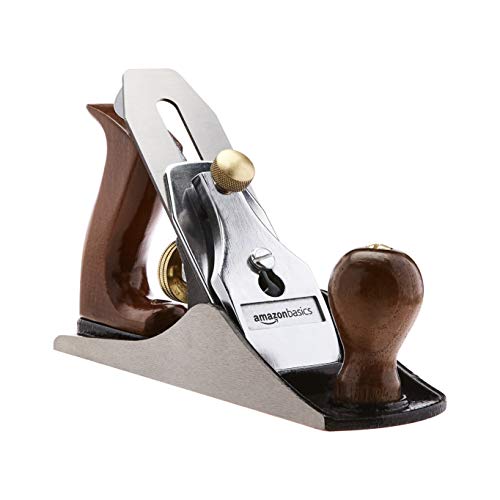
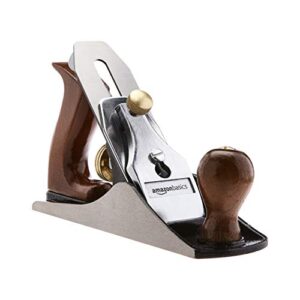
Amazon Basics No. 4 Verstellbarer Universal-Handhobel (50,8 mm Klinge) – Amazon Basics
Vorteile
- Hohe Laufruhe: Das schwere Gehäuse aus robustem Gusseisen dämpft Vibrationen und sorgt für ein stabiles Hobelbild.
- Präzise Zustellung: Über das integrierte Einstellrad steuerst du die Spanabnahme exakt, um feinste Oberflächen zu erzielen.
- Ergonomische Führung: Die konturierten Griffe aus echtem Holz bieten dir deutlich mehr Kontrolle und ein besseres Gefühl für das Material als Kunststoffgriffe.
- Standfeste Schneide: Die Klinge aus einer speziellen Stahllegierung hält die Schärfe auch bei härteren Holzarten über einen längeren Zeitraum.
Empfohlene Nutzung
Dieser Putzhobel der Größe No. 4 ist das ideale Werkzeug für dich, wenn du Oberflächen glätten, Kanten fasen oder Werkstücke exakt auf Maß bringen willst. Er eignet sich hervorragend für Weich- und Hartholz im Möbelbau sowie für allgemeine Tischlerarbeiten in deiner Werkstatt.
Produktbeschreibung
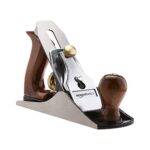
Der Amazon Basics No. 4 Handhobel ist ein klassischer Allrounder für die Holzbearbeitung. Das Herzstück ist der Körper aus Gusseisen. Durch das hohe Eigengewicht liegt der Hobel satt auf dem Werkstück, was dir das Abrichten und Glätten massiv erleichtert. Im Gegensatz zu billigen Blech-Varianten verzieht sich dieser Gusskörper nicht, was die Grundvoraussetzung für ein präzises Arbeitsergebnis ist.
Die Handhabung überzeugt durch die Verwendung von Holzgriffen. Diese sind nicht nur schlagfest, sondern liegen auch bei längeren Arbeitseinsätzen angenehm in der Hand. Die Konturierung des vorderen Knaufs und des hinteren Griffs erlaubt es dir, den Druckpunkt genau über der Klinge zu halten, um ein „Hoppeln“ des Hobels zu vermeiden. Die 50,8 mm breite Klinge aus legiertem Stahl ist für saubere Schnitte ausgelegt und lässt sich über das Einstellrad feinfühlig justieren.
Ein wichtiger Aspekt für deine Praxis: Wie bei fast allen Hobeln in dieser Preisklasse ist ein wenig Vorbereitung nötig. Du solltest die Klinge vor dem ersten Einsatz auf einem Schleifstein abziehen, um die maximale Schärfe zu erreichen. Prüfe zudem mit einem Haarlineal die Sohle. Sollte diese minimale Unebenheiten aufweisen, kannst du sie mit Schleifpapier auf einer planen Fläche (z.B. einer Glasplatte) perfekt abrichten. Sobald dieses Setup steht, liefert der Hobel Ergebnisse, die sich vor deutlich teureren Markenmodellen nicht verstecken müssen.
Durch die einfache Verstellbarkeit der Spanabnahme kannst du zwischen grobem Schruppen und feinstem Putzen wechseln. Das macht den No. 4 zum wichtigsten Hobel in deiner Grundausstattung, da er die Brücke zwischen Materialabtrag und Oberflächenfinish schlägt. Ein ehrliches Werkzeug für Anwender, die Wert auf ein solides Preis-Leistungs-Verhältnis legen.
Technische Eigenschaften
| Eigenschaft | Wert |
| Typ | Putzhobel / Bankhobel No. 4 |
| Klingenbreite | 50,8 mm (2 Zoll) |
| Material Gehäuse | Gusseisen |
| Material Griffe | Holz (konturiert) |
| Material Klinge | Stahllegierung |
| Einstellmechanismus | Rändelrad für Schnitttiefe |
| Anwendungsbereich | Glätten, Abrichten, Fasen |
For a plane the price is good, but it was not good quality craftsmanship out of the box. Material stock is solid, iron is a decent thickness, locking plate and chip breaker galvanised with zinc. Since renovating is required to get a decent cut, it may be preferred to buy a more expensive brand or hope for luck at the market.Good points:No cracks, weak spots or stress concentrators. Real wood used for handles.Quality issues:Base 2 degrees out of square to fences.Fences 1 degree out of parallel to eachotherBase ~0.2 out of flat. Wavy dip down centre of base.Both fences ~0.4 out of flat.Cutting iron:- surface contact with frog ~0.1 out of flat- blade edge surface ~0.2 out of flat, biggest variance in corners of blade.Chip cutter:- Cutting iron contact surafce 0.2 out of flat- blade stabiliser ~ 0.1 out of flatFrog:- blade contact surface ~ 1 out of flat (rough milled and spots of paint- contacts with base ~ 0.5 out of flat (but pretty square)Base contacts with frog (measured after base lapped micron flat) left contact 0.3 closer to base.Galvanised parts rust quickly when coat is broken.Personal preference, not a fan of the varnished handles, sanded them back and oiled them to be pleasantly surprised by wood underneath.Total renovation time ~30 hours.Budget was limited, so I thought I would have to hope to find a second hand plane at the market or on Kleinanzeigen, I decided to buy this new in hopes of avoiding renovation. At least the materials feel new, so it is not as bad as a plane from unknown sources, but it is not carpentry standard either.
The plane looks the part. Out of the box it does not work. But that's about it. It rattles and sticks, requires the slant to be adjusted to one side entirely for the knife to catch across the width, and catch it does. I couldn't get a good chip or a plane surface.But I bought it as a project anyway. I saw a video on making it perform well, and that piqued my interest. I'm the type of person that adjusts, fine-tunes and fine-finishes most of their tools anyway. But I must admit it was worse than I expected. So this is what I fixed:The frog seems to have been dropped at some point, and the tip of one of the lower supports was bent upwards. That is the reason I couldn't get any chip out of it and why it cut unevenly: the top surface was not plane and the blade wasn't sitting on it. The lower frog contact surfaces were phantastically bad. I can't even guess at what tool was taken to it, one of them looked for all the world as cut with a chainsaw, with deep grooves. The angle was wrong, and the surface was more semicircular towards the edges than flat. So I filed that plane, then planed the top surface (which had a big dip in the middle), and also the other mating surface (which was all over the place as well). Put it back together, still wouldn't cut. Knife looked and felt sharp, but wasn't. So I gave it a quick secondary bevel and a bit of flattening, and it finally started cutting. However while honing it i found out that the knife metal was quite soft. So I decided to harden it, and managed to crack it in the process. I then annealed it again, cut the cracked part off, hardened it with a bit more care, ground it flat, ground a new 40° bevel, honed, lapped and polished it.So now it performs extremely well. That doesn't mean that all is great. The sole is not square to the sides, the knife is too thin, the adjustment mechanism lever is a bit too short on both ends and connects with neither the knife nor the adjuster wheel properly, it's axle is loose and grooved so it binds, and there is a lot of slop in the adjustment wheel. I'll probably end up making a completely new lever – file it from steel or brass, or 3D print it in polycarbonate and pin it with a close-fitting axle (polished spring steel with a brass bushing probably). I also want to give the handles a better finish, and ultimately perhaps even square up the sole, but that's not a priority.So why 2 stars? You don't have to go the lengths I went. You could get by with a bit of finishing and adjustment. I don't assume you'll get the level of damage (bent frog) like I did, and mine is a return anyway. The basis is quite solid, and you can improve on it. The solid base is already worth the money. It's decidedly NOT for beginners, since they may fail to get any results with it and come off with a wrong impression.
Einstellung hat bis zur Fixierung ein bisschen Spiel, sonst alles super. Ausreichend scharf und das Ding hobelt sauber und gerade auch in Buche.Griffe liegen gut in der Hand und der Hobel sieht auch wertig aus. Würde ich wieder kaufen.
Production quality is mediumIt's fully functionalThe adjusting is easyThe precision is satisfactory
Preis Leistung ist super! Ich habe die Klinge nachgeschärft alles neu eingestellt, und dann lief der hobel wie von allein …